Showing posts with label Technology. Show all posts

Sunday, August 31, 2008

LZMA Compressed Files

                        zipper_2

.LZMA file extension is nothing but a type of an extension of a compressed file (Lempel-Ziv-Markov chain Algorithem). This is mostly used with 7-ZIP archiver and also other archivers too.

7-Zip has a better compression ratios than bzip2 (.BZ2 files) and faster decompression.

Some LZMA compressed files can be opened with 7-ZIP(Windows) and 7zX(MAC). Other compressed files with LZMA can be opened by using LZMA SDK for windows computers and LZMA Utils for Unix.

Following are the programs that supports to open LZMA compressed files.

  • MAC OS : 7zX, Sixty Five
  • Windows : LZMA SDK(Download here), 7-Zip
  • Linux : Tukaani LZMA Utils, p7zip

DEEP INSIDE

Open source LZMA compression library is written in C++ and has the following properties:

  • Compression speed: approximately 1 MB per second on a 2 GHz CPU
  • Decompression speed: between 10 and 20 MB per second on a 2 GHz CPU
  • Support for multi-threading.

As of version 4.58 (beta) of LZMA SDK, there is also ANSI C reference implementation of LZMA compression and decompression routines available as well.

The 7-Zip implementation uses of hash chains, binary trees and Patricia tries as the basis for its dictionary search algorithm as theories.

Decompression-only code for LZMA generally compiles to around 5kB and the amount of RAM required during decompression is principally determined by the size of the sliding window used during compression.

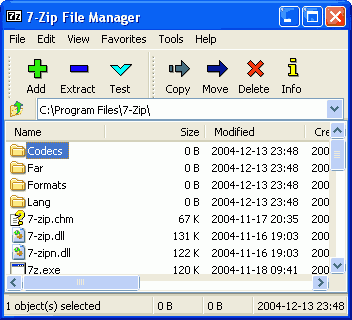
                   7zfm

Get 7-Zip File Manager(32-bit) or 7-Zip File Manager for free.

Thursday, August 28, 2008

Nvidia with Intel i7 to boost up Graphics!

Nvidia is enhancing its features for Intel's upcoming Core i7 processors.

The effort to expand Nvidia offerings on Intel's next high-end desktop platform, which had previously been referred to as "Bloomfield." Intel named it Core i7. As a part of i7 design Nvidia has planned that it has no intention to build a chipset for Intel's next-generation interconnect technology called QuickPath Interconnect or QPI, which is part of the i7 design.

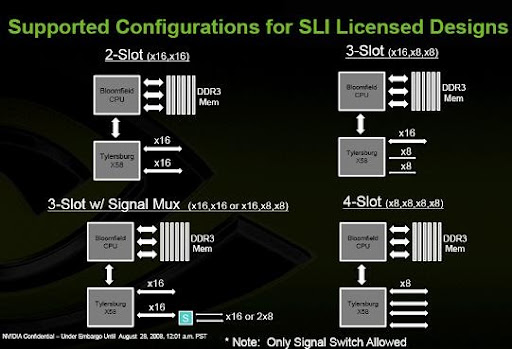
Nvidia will license its SLI technology for Intel's Core i7 processor. Nvidia's technology will work in tandem with Intel's X58 chipset, the supporting silicon for the Core i7.

     nvidia-sli-bloomfield-license-small-2

SLI allows systems have multiple graphics boards. So, for example, system builders and users can build systems with two, three, or four Nvidia boards.

Till now, Nvidia has only offered nForce 200, "which is basically an SLI chip that acts like a PCI Express bridge. That's been the only solution and that's been a very high-end solution.

PCI (peripheral component interface), is the most common interface inside a PC for add-in boards.

This is something that customers have been asking from NVIDIA for a long time!!

On another front, Nvidia will announce a new high-performance "motherboard GPU" in the coming weeks. This will be a follow-on to its GeForce 8200 mGPU.

The upcoming mGPU will compete with the Intel G45 integrated graphics chipset.

Thursday, July 31, 2008

A Vehicle Runs with Water for the First Time In Sri Lanka

                    7-31-2008 11-51-44 PM

Thushara Priyamal was the eldest of Edirisinghe family in Athurugiriya who had an interest for researching scientific substances since school age. He was a much recognized past pupil from Kristhu College Pannipitiya. Starting from 9th grade he wanted to research on producing Hydrogen gas using water.
He learned how to fill air to balloons by adding a piece of Aluminum into Caustic Soda mixed with water and also found that the balloon gets exploded if it is taken near a fire. So he thought, collected Hydrogen could produce enough power to start a vehicle engine.
Thushara had a good knowledge about electric parts of a vehicle and he had an interest in improving his skills very much by going to a Mechanical Engineering Institute. So he stopped his education after he passed O/L's on 1996. Since he achieved tremendous results at O/L's he was selected to for Electrical Engineering at Moratuwa German College in year 1998.
By this time he wanted to make an airplane. He was able to airborne a small airplane which is made of Rigifoam and necessary electrical parts. He was successful more than he anticipated, because it could fly so far that even the connection with the remote control was lost. He lost the model because of the unexpected performance of this hand made aircraft. After finding the airplane, he never attempted to airborne it again, because he was advised from the air force not to airborne unlicensed air planes more than 8 Kilo meters away from the source.
After he joined Electrical Engineering at Moratuwa German College in year 1998, he proved his core competencies very well by performing at his studies remarkably well comparing to the other students. Most of the time when he is at home, he repaired vehicles and continued his own researches on motor mechanics. After completing studies in year 2004, he started to work in the field he always had a passion about. Since he was busy with the job, he couldn't manage time to do his own researches. So he planned to leave the job and continue fulfilling his endeavors. Then he continued his researches collecting enough Hydrogen gas to start a vehicle and he succeeded on December 2006. According to that he made an electrical circuit.
This circuit produces enough Hydrogen gas using only water to start a vehicle. A fluctuation was generating by fixing a special electrical circuit into a water tank that can hold around 3 and a half liters of water. It produces Hydrogen gas and Oxigen gas consuming a small beam of electricity. Combination of these two gases can make a vehicle engine start. But unfortunatly he didnt have a vehicle to do his researches. But thushara didnt give up. He fixed his circuite into one of him friend's vehicle. He succeeded. So he drived all the way to Anuradhapura, Kurunagala , Puttalama etc with his new found vehicle for around 1 month time. Suddenly the owner of the vehicle has taken the vehile away from him with the circuit. He has requested the circuit from him, since he worked hard to find it. But he has not recieved it back. Still he didnt give up. He has started to make a new circuit on march of last year. He succeeded to finish it by july of this year. Since he didnt have his own vehicle he had to test it in other's vehicle once more. In the same way has tested for around 1 month. The same story happend at this time also, but he has not given his new research this time.
This circuit produces enough gases to run 80Km with only 1 liter of water. As he says the output is nothing but water vapor. He thinks to improve and make a release to the country, since there is a huge problem of fuel in Sri Lanka. He thanks to his family, Burnard Nydef and Kumudhu Nudef for giving strenght to succeed this new research.
He has wasted so much of money to come into this position. This can be helpful to our country as well as to the whole world.

Thursday, July 17, 2008

Assassin's Creed DirectX 9 vs. DirectX 10

Assassin's Creed is yet another title in recent times to offer the ability to run in DirectX 10 mode. Basically DirectX 10 mode can only be run under Windows Vista, so if you're running Windows XP Assassin's Creed will automatically run only in DirectX 9 mode, while in Vista you get the option of both DX9 or DX10, though by default it automatically runs in DirectX 10 mode.

To manually choose which mode to run the game in under Windows Vista, unfortunately you cannot use the normal trick of right-clicking on the game icon in Games Explorer and choosing the mode, as the option doesn't exist. Instead, you should create separate desktop icons for launching Assassin's Creed in DX9 and DX10. Go to your \Program Files\Ubisoft\Assassin's Creed directory and right-click on the AssassinsCreed_Dx9.exe file, and select Send To>Desktop; do the same thing for the AssassinsCreed_Dx10.exe file. You can now use these desktop icons to launch the game in the relevant mode as desired. If you're running the Steam version of the game, you need to backup the DX10 .exe to another location and then delete it from the main game directory, then rename the DX9 .exe file to the same name as the DX10 .exe - the game will now run in DX9 mode when launched.

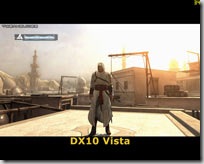
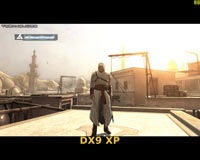
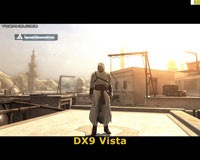
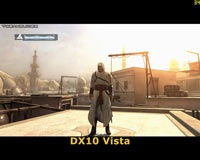
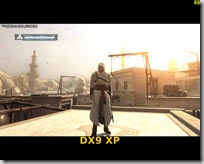
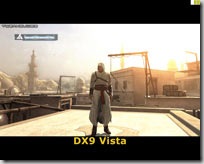
Below we look at the performance and graphics quality of the game in all three: DX9 XP vs. DX9 Vista vs. DX10 Vista. I ran the game on my XP/Vista dual boot on this system. For all three modes the exact same in-game settings were used (everything at maximum), along with identical settings in the graphics card control panel (everything at the highest possible quality, no additional AA/AF). I've used both a static scene with no moving objects, as well as a typical city scene with some NPCs. Because the game does not allow restoring specific save points, the scenes may vary slightly in composition and/or angle. FPS is shown at the top right of each shot, but is also reproduced for easy reference:
AC_10as

AC_10bs 

                   AC_10cs

FPS Results - DX9 XP: 46, DX9 Vista: 33, DX10 Vista: 34

XP DX9 vs. Vista DX9: In the first set of comparisons, all three modes look pretty much identical in terms of image quality. However performance is clearly superior in XP DX9 mode. In the second set of shots, XP DX9 and Vista DX9 modes look identical, save perhaps for slightly better antialiasing in Vista DX9 - examine the flat wooden roof at the middle right of the screen, it appears slightly less jagged in Vista DX9 mode. However Vista DX9 is also noticeably lower in FPS than XP DX9, so any tiny image quality benefits come at the cost of framerate.

DX9 vs. DX10: In the second set of shots we start to see some noticeable differences between DX9 and DX10 mode. The significant difference is in the shadows - the DX10 shot is slightly darker and richer than both the DX9 shots, despite the same Brightness level in all three (5/10 on the slider), mainly because the shadows are darker. DX10 mode also seems to have different shadow quality to DX9 mode - compare the shadows on the palm fronds, they're much more detailed in DX10 mode. Furthermore, look at the shadows on the building to the far left, especially under the dome and around the windows - there are less glitches visible. Indeed in a range of other places in the scene, there are less shadow glitches in DX10 mode, though there are different glitches visible in DX10 mode, such as the horizontal shadow lines on the two palm fronds on the left of screen for example. It should be noted that both DX9 and DX10 mode in Assassin's Creed have an identical maximum shadow map resolution of 1024x, which is what all shots above are using, so any difference is in the way they're rendered in each mode.

What the screenshots don't show too well is that in DX10 mode, the implementation of Bloom and Multisampling also results in slightly better image quality. It's very subtle, but it does seem that DX10 mode provides that extra edge in the visuals. However it is by no means highly noticeable - the only real difference is in the shadow quality as demonstrated above.

Importantly, note that the performance differences shown above are indicative only. Generally speaking, XP DX9 mode should be faster than Vista DX9 or DX10 mode on most systems, however the actual level of difference between all three modes will vary based on the system being used. The developers of Assassin's Creed have stated that DX10 mode is supposed to be faster than DX9 mode in Windows Vista, and also provide greater potential for improvement via driver optimizations. Again, whether this is what you experience or not will depend on your system, as Assassin's Creed is both CPU and GPU-intensive, and if one or the other is slower on your system, it can bottleneck your results, depending on your resolution and settings.

Thursday, July 10, 2008

Pioneer develops Blu-ray compatible disc that holds 400GB

On July 13 Pioneer will be giving a presentation at the International Symposium on Optical Memory and Optical Data Storage where they'll discuss recent advances that apparently make discs with up to 16 layers possible. Although other companies have found ways to radically increase the number of layers on an optical disc, Pioneer seems to be the first company to manage it with as much as 25GB per layer, making it very similar to Blu-ray.

In fact the company has said "it is possible to maintain compatibility between the new 16-layer optical disc and the BD discs." That could potentially mean a single Blu-ray disc capable of storing up to 400GB with the new technology.

Of course that's assuming a number of things, including that manufacturing costs, which are already very high for even single layer Blu-ray discs, come down significantly. The large amount of data per layer for Blu-ray increases the precision required to make them compared to DVD, resulting in a higher percentage of bad (unreadable) discs. It's reasonable to assume that putting 16 such layers on a single disc would lower yields even further.

There's certainly potential for adding just 2 or 3 more layers to accommodate increased resolution in future generations of HD video. At the same time, Blu-ray is limited by more than just storage capacity. It only makes sense that even higher resolutions would also require higher data throughput to accomodate increased bitrates, just as DVD's 9.8Mbps was deemed insufficient for current generation HD video.

So for now it's certainly an interesting development, and perhaps even revolutionary, but don't make any plans to buy 400GB Blu-ray discs any time soon.

Wednesday, July 9, 2008

Microsoft To Launch Windows Small Business Server 2008 On Nov. 12

An early release version of Windows Essential Business Server 2008, Microsoft's mid-sized business product, will also be released in November.

Microsoft (NSDQ: MSFT) on Monday said it would launch in mid-November a series of products aimed at small businesses that need up-to-date computer technology but lack large IT staffs to handle installation and maintenance.

The company said it would ship Windows Small Business Server 2008 and Windows Essential Business Server 2008 on November 12. The company also said trial versions of both products are now available for download through a Microsoft site called MultiplyYourPower.com.

Windows Small Business Server 2008 is a scaled-down version of Windows Server 2008, which is the server OS counterpart to the Windows Vista desktop operating system. The standard edition comes with Microsoft Exchange Server 2007, Windows SharePoint Services 3.0, Windows Live OneCare for Server, and other utilities.

The Premium edition adds the small business version of SQL Server 2008 and several other technologies drawn from Windows Server 2008.

Windows Essential Business Server 2008, which Microsoft developed under the code name Centro, is designed for mid-sized businesses with more sophisticated IT needs, and offers a range of additional messaging, management, and security tools.

Microsoft on Monday also disclosed that Dell, along with Europe's Wortmann AG, will build and sell servers and other products powered by Windows Small Business Server 2008 and Windows Essential Business Server 2008.

The small- and mid-sized business markets represent lucrative growth markets for Microsoft and other tech vendors. IDC predicts that worldwide IT spending by SMBs will grow at a rate of 7% annually through 2012, compared to a 5.2% growth rate for the IT market overall during the same period.

Pricing for Windows Small Business Server 2008 starts at $1,089. Windows Essential Business Server 2008 starts at $5,472.

Radeon HD 4870: Better Than GTX 260!

Only a few days ago, everything seemed perfect in the best of all possible worlds for Nvidia. The card manufacturer had just launched its GeForce GTX 260 and 280, which – despite the six-month delay – pushed the unified architecture introduced with the GeForce 8 to the limits of what a 65-nm process and a gigantic number of transistors could offer. The performance gain compared to the former –and now older – generation wasn’t overwhelming (59% on average over a 9800 GTX), but the arrival of CUDA applications was an interesting development, and Nvidia had no competition. Meanwhile, AMD seemed to be ever deeper in the red with its graphics division, avowedly incapable of competing on the high-end market segment as it once did, with its existing high-end cards quickly aging performance-wise. Then came the hush-hush release of the Radeon HD 4850, even before anybody had time to test it, and at an astoundingly low price of $199.


Yet, in the AMD camp, a miracle has happened. The Radeon HD 4850’s performance surprised everybody – including Nvidia. Despite the last-minute launch of the GeForce 9800 GTX+, which will not be available in retail channels until mid-July, Nvidia simply can’t match the explosive performance/price ratio of the Radeon card as we demonstrated in our recent test. The familiar marketing pitch about optimizing efficiency and the architecture’s yield, which has always sounded like fluff, suddenly took on a new meaning considering the Radeon HD 4850’s test results. It also even awakened hopes of an even better performance in the future. Having managed — to its own surprise — to increase the number of multiprocessors from 320 to 800 despite a 43% increase in the number of transistors and at the same engraving depth, AMD doesn’t want to settle for playing in the minors – and for good reason. A Radeon HD 4870, based on the same architecture but with higher performance (and of course at a higher price) has been announced and is slowly beginning to be available, though there’s still some uncertainty about that last point. On paper, at least, it could directly compete with Nvidia’s new high-end cards, and at a significantly lower price. But how about in practice?

Samsung Puts 128 SSDs Into Mass-production

Samsung today said that it has begun mass producing 1.8" and 2.5" multi-level cell (MLC)-based solid state drives (SSD) with 64 and 128 GB storage capacity. Samsung also promises "more attractive" pricing, which indicates that SSD technology will become more competitive with traditional hard drives and be in reach for more consumers.


Samsung’s announcement has written "mainstream" all over it - it does not offer those speedy data transfer rates we have heard in recent weeks and there is the note about "attractive pricing". Of course, that brings up the question how much these drives will cost. Samsung traditionally does not comment on price and, not surprisingly, spokesman John Lucas declined to comment on possible pricing. But we can speculate.

Before we do that, let’s have a quick look at the specifications of the drives. Samsung claims that MLC based SSD has a write speed of 70 MB/s and a read speed of 90 MB/s, which are performance levels that are well below single-level-cell (SLC)-based SSDs which can achieve read speeds of 130 MB/s. In fact, Samsung’s new SSDs are even a bit slower than today’s fastest hard drive, WD’s 3.5" Velociraptor.

Samsung claims that the 128 GB SSD, which is built from 64 MLC NAND flash memory chips of 16 GB each, is energy efficient at 0.2 watts in standby mode and 0.5 watts in active mode. Probably most interesting is the drive’s expected life: Samsung claims the drives will last 20 times longer than the average 4-5 years of hard drives - which would mean that the SSD is rated at 80-100 years.

So, what about the price? Considering the fact that these drives are in mass-manufacturing, the fact that there is talk about "more attractive" pricing in an environment where entry-level 64 GB SSD notebooks can be purchased for about $1600 (check Dell) sounds to us like SSDs are finally ready to take a first shot at the upper mainstream segment of computers. This would mean that vendors such as Dell would have to drop the current $600 price of 64 GB substantially: Flash prices typically fall by about 40% every year and $300-$350 for a 64 GB drive sounds realistic to us.

In any case, you may want to begin looking a bit more seriously at this segment if you are interested in purchasing a SSD or a computer with such a drive.

But don’t get too excited just yet. Hard drives are still cheaper and Samsung’s vice president of memory marketing, Jim Elliott, said in a statement that these 64 GB and 128 GB MLC SSDs are aimed at "business users and many PC enthusiasts". So far, the company is not talking about "value" PCs.

Samsung said it will introduce a later this year.

Thursday, July 3, 2008

You choose DirectX 10 or DirectX 9 ?

Simply put, DirectX® is a Windows technology that enables higher performance in graphics and sound when you're playing games or watching video on your PC.
At the core of DirectX® are its application programming interfaces, or APIs. The APIs act as a kind of bridge for the hardware and the software to "talk" to each other. The DirectX® APIs gives multimedia applications access to the advanced features of high-performance hardware such as three-dimensional (3-D) graphics acceleration chips and sound cards. They control low- level functions, including two- dimensional (2-D) graphics acceleration; support for input devices such as joysticks, keyboards, and mice; and control of sound mixing and sound output.
Because of DirectX®, what you experience with your computer is better 3-D graphics and immersive music and audio effects.

DirectX®10 Benefits
DirectX®10 offers a wide variety of benefits to gamers. Let's dive into the details now:
• More Life-like materials and characters

               DirectX10_screen

                          DirectX 10 in crysis

                     DirectX9_screen

                             DirectX 9 in Halo

You can see the difference for yourself when we compare Picture 2, a screenshot taken from 'Halo: Combat evolved', a PC game which was among the best of its class at release to Picture 1, an image from 'Crysis', a PC game which is slated to release soon. Halo uses DirectX®9.0b to support its graphics while Crysis makes use of DirectX®10.
DX10 adds a new level of realism to games by making characters more life-like. You can see the incredible detail in the screenshot above. The facial expressions, details of the face, the handle-bar moustache and the glazed looking eyes all add to the realism.